For years, a business website had a fairly straightforward job: help people find you, explain what you do, and give them an easy way to get in touch.
That's still important. But the way people find and use information online is starting to change.
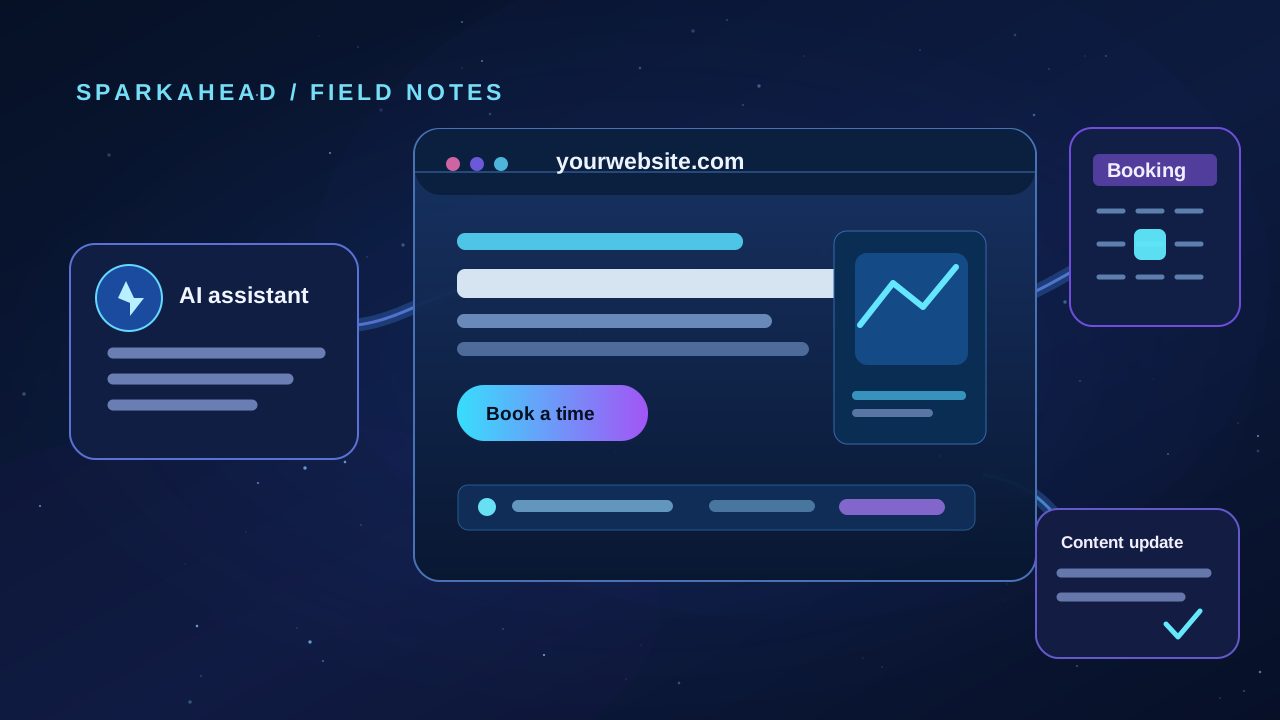
Instead of opening ten tabs to compare businesses, someone might ask an AI assistant to do the research. Instead of looking through a booking calendar themselves, they might ask the assistant to find a suitable appointment. And instead of logging into a website dashboard to change a paragraph, a business owner may soon be able to ask their usual assistant to make the change for them.
The next generation of websites will need to work well for people and the software acting on their behalf.
I think that's one of the most interesting shifts happening in web development right now. And it's particularly relevant for small businesses that don't have the time or budget to run complex digital systems.
What do I mean by an "agent-ready" website?
I break it down into three levels: discover, understand and act.
1. Discover: can an assistant find your business?
Imagine someone around Taree asking an assistant, "Find a local business that offers beginner riding lessons and tell me which ones are suitable for children."
The assistant needs dependable information to work with. If your website is hard to access, incomplete, or vague about what you offer, you're making that job harder.
This part is less futuristic than it sounds. The basics of good SEO still matter: clear page titles, useful written content, accessible pages, working links, accurate business details and a website that performs well on mobile.
Google's own guidance for AI features in Search says there are no secret AI-only optimisation requirements for appearing in those experiences. Good, people-first web development remains the foundation.
No one can promise that an assistant will recommend your business. What we can do is make it easier for systems — and customers — to find accurate information about you.
2. Understand: can it tell what you actually offer?
A restaurant website might say "Join us by the water" and show a beautiful gallery. That's useful for atmosphere, but a customer may also need to know when dinner is served, whether bookings are required, and what dietary options are available.
An AI assistant needs that practical information too.
For a small business, this means making the important facts clear and easy to keep current: services, prices where appropriate, opening hours, service areas, policies, booking links and ways to contact you.
Structured data can help search systems interpret those details, provided it accurately reflects what's visible on the page. But structured data isn't a substitute for useful content, and it certainly isn't a magic switch for AI recommendations.
A beautiful website still needs to answer real questions.
3. Act: can an assistant help someone get something done?
This is where things start getting genuinely interesting.
A visitor might want to book a consultation, check appointment availability, send an enquiry or purchase a personalised product. Increasingly, AI tools are being built to help people complete those sorts of tasks.
But there's an important distinction between reading a website and acting on it.
Making actions reliable often requires an actual booking system, a well-designed API or a supported tool connection. It also requires sensible permission checks, accurate availability, clear confirmation and safeguards around payments or personal information.
New technologies are emerging to help with this. Model Context Protocol (MCP) provides a way for assistants to work with external tools. Browser-oriented proposals such as WebMCP are also being explored, although they're not something I'd treat as universal production support today.
For a small business, the practical starting point is simple: make booking, enquiries and other important actions straightforward and reliable now, then add agent integrations when they actually improve the customer experience.
What about the person who owns the website?
This might be my favourite part of the whole idea.
Think about how many small-business owners have a website they hardly ever update, not because they don't care, but because logging into a CMS, finding the right page and working out what to change is a nuisance.
Now imagine the restaurant owner saying to their existing AI assistant:
"Update our trading hours for next Monday, add this new photo to the homepage, and show me a preview before you publish anything."
Or a tradesperson saying:
"Add the photos from the latest job to our gallery and update the service area to include Wingham."
The assistant could read the current content, prepare changes and show the owner exactly what would go live. The owner approves, and the website updates.
No new chatbot to learn. No separate AI app to install. Just the assistant they already use, connected securely to their own website.
That's a direction I'm exploring for SparkAhead's future content-management tools. The concept is technically feasible through an authenticated content API and a reusable remote MCP connector, but I want to be clear: this is a development direction, not a feature I'm claiming is already live for every SparkAhead customer or available through every AI app.
And I'd insist on a few protections from day one: limited permissions, draft previews, explicit approval before publishing, a record of changes and an easy way to undo mistakes.
The goal is to make managing a website easier without giving up control.
What should a small business do today?
You don't need to rebuild your entire website around an experimental protocol tomorrow.
Start with the practical things:
- Make your services, opening hours, location or service area, and contact details accurate and easy to find.
- Ensure the site works properly on phones, loads quickly and has useful text alongside its visuals.
- Use a reliable booking or enquiry system if those tasks are important to your customers.
- Keep ownership of your accounts, customer data and domain clear.
- Choose technology that can connect to other systems later, without forcing you into one provider.
A new site can be designed with these things in mind from the start. An older site can often be modernised in stages.
And it's worth avoiding the shortcuts. Adding an AI chatbot to every page doesn't automatically make a business "agent-ready". Neither does publishing dozens of generic AI-written articles stuffed with keywords.
Useful information, reliable functionality and thoughtful integration matter more than buzzwords.
Building for what comes next
At SparkAhead, I'm combining AI-accelerated development with years of practical software-building experience. That lets me move quickly while still concentrating on the parts that matter: design, usability, reliability and maintainability.
I'm based in Wingham on the NSW Mid North Coast, working with businesses around Taree and further afield. I want to help local businesses get websites that look excellent today without becoming outdated the moment the next big change arrives.
No one knows exactly how people will use AI assistants in five years. I certainly don't pretend to.
But I do think the direction is clear: websites are becoming more than digital brochures. They're becoming useful, connected parts of how businesses operate.
And that's a future worth building for.
Have an existing website that's ready for a rethink? Tell me what you're trying to achieve.